


Everything Carries Its Before
Te is the Sinhala word for tea, a word I grew up hearing in a particular rhythm. It began in the morning, passing softly between my parents: Te, as an offering, a question, the first negotiation of the day. Later, it moved through the house as the day unfolded, punctuating the ordinary. The word repeated itself, the way small rituals hold a household together. Te when someone needed rest. Te when guests arrived. Te in the afternoon, when everything paused, when people settled into chairs and voices softened, and the world became briefly smaller and warmer. When we searched for a name, we kept returning to that repetition: te te te. Three times, like a spell, as if to stop time.

Tetete began there, in the small ceremony of daily life. Over time, it became a way of paying closer attention to the pleasures we return to. The simple act of pouring hot water over leaves opened onto larger questions of how anything comes to be. A quiet realisation that everything that exists carries its before.
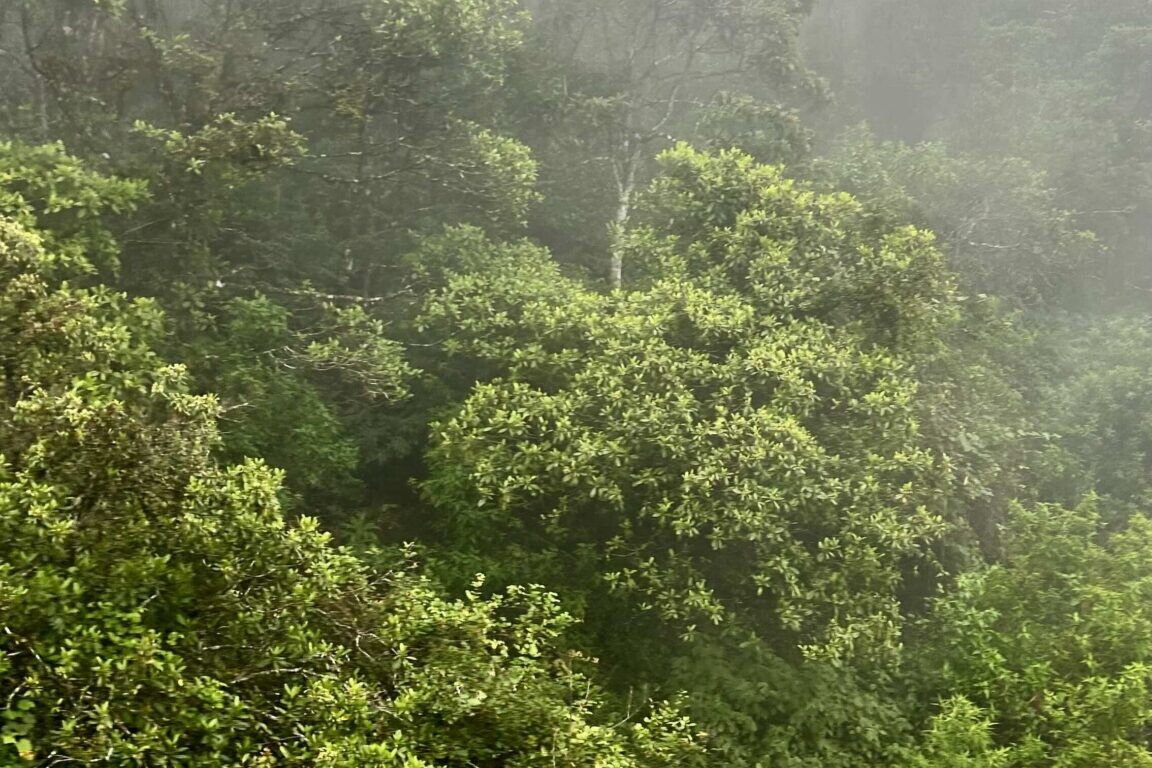
For Tetete, Sri Lanka is our first place of inquiry. Tea there is intimate and everyday, but also bound up with empire, export, and the name “Ceylon.” Behind that name is a tangled history, and people whose knowledge and devotion are too often overlooked. We began looking toward smaller producers working from estates and family gardens, where another kind of knowledge is still kept in practice.
A few of our producers tend heirloom varieties; others craft only in small batches or follow the season rather than the market’s demand for sameness. Their work is slower and less predictable because it stays in conversation with nature. Through them, we began to see Sri Lankan tea differently. Not merely as black tea or a familiar label, but as a world of unexpected forms: white teas made from tender buds, green teas shaped by hand, and leaves gathered from wild trees reaching high above us. Some teas appear briefly, and others cannot ever be repeated.
This is part of what drew us in. The tea was not fixed; it was alive to weather and altitude. A batch could carry the brightness of a dry spell, the softness of too much rain, or the judgment of a maker who knew when to wait and when to move. As we learned more, tea stopped feeling like a product and became a way of seeing a place more closely.
Tetete tries to keep that particularity intact. We share our teas alongside the conditions that shaped them, so the cup does not arrive alone. Once you understand what a leaf has passed through, treating it as ordinary becomes almost impossible.
In a culture that teaches us to expect sameness, allowing nature to be unpredictable felt like a gentler intelligence. Observing its rhythm, we had no desire to correct it, only to stay near it. To work with nature in this way is to accept that the relationship will never be entirely symmetrical. People bring skill, intention, and care; the land brings its own terms.
Tetete comes from that relationship. One shaped by love for the land and the people that tend it. I keep thinking about whether that feeling can travel. Whether something of the place, the season, and the person who made it can reach the person drinking it. This is what I hope for, more than anything: a new way of paying attention to what is fragile, seasonal, and true.


